Doniphan County seat, platted in 1855
Sewer Line Repair in Troy, KS
Straight answers for a small town where every house has its own plumbing history, with visits scheduled from St. Joseph.
- Free on-site estimates
- Camera footage of your line before any digging is quoted
- Written, itemized quote with permit and restoration listed
Small Town, Old Pipes, Clear Answers
Sewer Line Repair in Troy is a small-town job in the best sense: fewer than a thousand people, a few hundred homes and a lot of houses that have been patched and updated by hand over the years. Troy was platted in 1855, its first house went up in 1856, and it was incorporated as a city in 1860. It started as a stop on the wagon route that ran west from St. Joseph toward Oregon and California. Today it is the county seat of Doniphan County, on the Kansas side of the river from St. Joseph, and we come across to work on drain and sewer lines here.
Is your home on the town sewer?
Before anything else, it is worth being honest about this. Sewer line repair applies to homes that send wastewater to a public sewer system. Plenty of houses in rural Doniphan County outside town limits run to a private septic tank instead, and septic work is a different trade that we do not do. If you are not sure which you have, your utility bill or city hall can tell you. If you are inside Troy and pay a sewer charge, you are in the right place.
The usual suspects in a Troy lateral
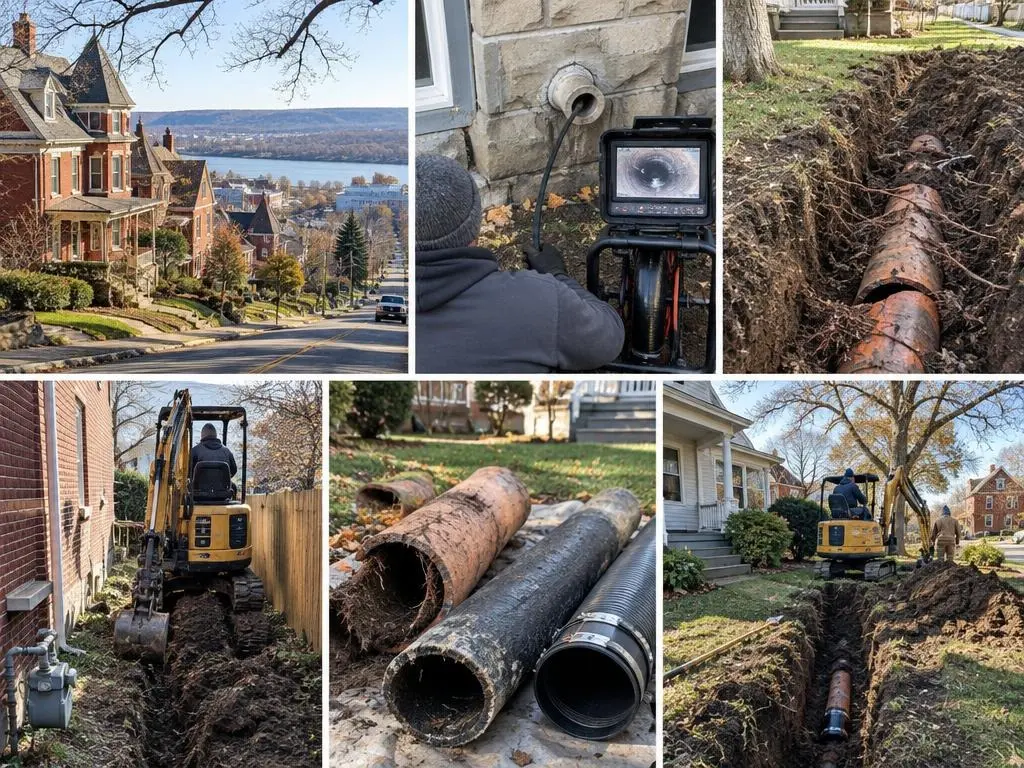
In a town of this age, the line from the house to the street was often replaced in pieces. Laterals in a town this age commonly include a few materials:
- Clay tile joined every few feet, where roots from yard trees find their way into the joints
- Cast iron that has scaled up inside until the opening shrinks
- Fiber pipe (Orangeburg) from the mid-twentieth century, which can soften and flatten out of round
- PVC sections from newer repairs, sometimes glued to old pipe with a rubber coupling
A camera inspection shows which of these you have and where the transition points are, because transitions are where trouble tends to start.
Up on the hill
Troy sits at about 1,089 feet, higher than the river towns to the east. Slope matters in a sewer line: a lateral needs steady fall toward the main to carry solids. A line with a belly, a low spot where water sits, will keep catching paper and grease no matter how often it is cleaned. We measure that on camera and tell you whether cleaning will hold or whether the section needs to be relaid.
Making the trip worth it
Because we come from St. Joseph, we plan a Troy visit to get as much done as possible in one trip. That usually means arriving with a camera, a locator and a jetter, so that if the problem is roots we can clear them on the same day, and if it is a broken pipe we can mark its exact location and depth on the ground for the estimate. When repair work is needed, the written quote lays out spot repair, lining and replacement side by side where each is realistic.
Near the square and under the street
Troy's business district has a brick street. If your sewer connects to the main under a street, or a repair would mean opening pavement or sidewalk, that part involves the city. We will not cut into public right-of-way without the city's say-so, and we let you know early if your job is likely to reach that far.
Common complaints
Typical complaints in an older town are slow drains, a toilet that bubbles when the washer drains, or a smell in the basement. Each of these can point to a partial blockage in the lateral. A single clog cleared once is not much to worry about. Repeat clogs every few months usually mean roots or a damaged section, and that is the point where a camera inspection pays for itself.
Call (816) 680-4869 to set up a visit or
for a free written estimate.Troy at a Glance
- An 1850s town plan. Troy was platted in 1855, its first house was built in 1856 and it was incorporated as a city in 1860, so parts of town have been built on and rebuilt for well over a century.
- A few hundred households. The 2020 census counted 964 residents in 375 households. In 2010 the city had 467 housing units and 421 households, so the number of occupied homes has been shrinking.
- County seat on the high ground. Troy is the county seat of Doniphan County and sits at an elevation of about 1,089 feet, well above the Missouri River towns to the east.
- Wagon-road origins. The town grew from a stop on the wagon route between St. Joseph, Missouri, and Oregon and California, and its business district still has a brick street.
Troy Questions
Do you come out to Troy from St. Joseph?
Yes. Troy is on the Kansas side of the river, and we schedule visits there. We bring inspection and cleaning equipment on the first trip so a simple root problem can often be handled the same day.
My house is outside Troy on a septic tank. Can you help?
Probably not. Our work is on sewer laterals that connect to a public sewer. Septic tanks and drain fields are a separate specialty. If you are unsure which system you have, check whether you pay a sewer charge.
Why does my drain keep clogging even after it is cleaned?
Repeat clogs usually mean the pipe is catching debris: roots at a clay joint, a flattened section of fiber pipe or a low belly. Cleaning clears the symptom. A camera inspection shows the cause.
What if the problem is under the street?
Any work in a public street or right-of-way involves the city. We tell you as soon as the camera shows the problem may be past your property line, and we do not open public pavement without the city's approval.
Free Estimates in Troy, KS
Free written estimates for in-town Troy homes.
Sewer Line Repair Near Troy
- Sewer Line Repair in St. Joseph, MO
- Sewer Line Repair in Savannah, MO
- Sewer Line Repair in Country Club, MO
- Sewer Line Repair in Agency, MO
- Sewer Line Repair in Easton, MO
- Sewer Line Repair in Gower, MO
- Sewer Line Repair in Cameron, MO
- Sewer Line Repair in Maryville, MO
- Sewer Line Repair in Plattsburg, MO
- Sewer Line Repair in Rushville, MO
- Sewer Line Repair in Dearborn, MO
- Sewer Line Repair in Platte City, MO
- Sewer Line Repair in Atchison, KS
- Sewer Line Repair in Elwood, KS
- Sewer Line Repair in Wathena, KS
- Sewer Line Repair in King City, MO
- Sewer Line Repair in Stewartsville, MO